
Reflect

Pause
Reflection is the pause between making and meaning — a moment to notice what has emerged and what continues to unfold. In this space, I trace the quiet dialogue between material and thought, gesture and insight. Each piece becomes a mirror, revealing not only its own form but the subtle shifts within my practice. To reflect is to return — to the body, to the process, to the quiet intelligence that guides creation.
_JPG.jpg)

My work has unfolded slowly, shaped by years of attending to the quiet intelligence of materials. What began as a fascination with texture and gesture has grown into a somatic practice — a way of listening through my hands, through repetition, through the subtle shifts that occur when attention softens. Teaching, travel, and long hours in the studio have each left their trace, widening the conversation between body, material, and meaning. act of creating.

My practice continues to evolve as an ongoing inquiry into presence — how we sense, how we make, and how we return to ourselves through the act of creating. Each piece widens the conversation between body, material, and meaning, inviting awareness to unfold through touch and time. Teaching, travel, and long hours in the studio have each left their trace, shaping a practice that listens more than it speaks — attentive to the quiet intelligence that guides creation.
Reflection opens a quiet space — a place where the threads of my practice begin to reveal their origins.

I once dreamed of Japan. Now I sit here, surrounded by its stillness — reflecting on what’s yet to come.
From this quiet space, my practice continues to evolve — an inquiry into presence and becoming.
Pathway
From this quiet space, my practice continues to evolve as an ongoing inquiry into presence — how we sense, how we make, and how we attune to the interplay between inner feeling and outer experience through the act of creating.

My process unfolds in quiet phases — sensing, making, and reflecting — each one a conversation between body and material.
Creative Process


Each artwork begins as a quiet dialogue between body and material — unfolding through movements of making, embodied inquiry, and reflection.
When the making pauses, reflection begins. I step back to sense what has emerged — not to judge, but to understand. Meaning unfolds slowly, like breath returning after movement. This phase is both closure and renewal, a moment of clarity before the next cycle of creation begins. It reminds me that art is never finished; it continues to evolve as perception itself evolves.
The pieces transform as they pass through through phases of gesture, material exploration, and reflection, each shaping the next in a quiet, evolving rhythm.


Movements of making
Gesture, touch, and repetition — where the work begins and the body finds its rhythm.
In the first phase of creation, I follow the impulse of gesture — the body’s quiet intelligence guiding the hand. Each movement is a conversation between intention and discovery. Through repetition, the rhythm of making emerges, and the work begins to reveal its own direction. This is where presence takes form, and the act of creation becomes a meditation on attention itself.


Rhythms, materials, and embodied inquiry
A dialogue between body and material — listening through texture, pattern, and process.

Here, the materials speak. Their textures, resistances, and possibilities shape the dialogue as much as my own touch does. I listen through the surface — through fiber, pigment, and form — allowing the process to teach me what it means to be attentive. This inquiry is not about control but about reciprocity: a shared rhythm between body and matter that deepens awareness.

_JPG.jpg)


Evolving process of sensing and creating
Reflection and emergence — where perception deepens and meaning unfolds.
When the making pauses, reflection begins. I step back to sense what has emerged — not to judge, but to understand. Meaning unfolds slowly, like breath returning after movement. This phase is both closure and renewal, a moment of clarity before the next cycle of creation begins. It reminds me that art is never finished; it continues to evolve as perception itself evolves.


From reflection, I return to the roots — the quiet sources that shape how I sense and create.

Since the age of four, I have known myself as an artist. This first came into focus when my kindergarten teacher asked us to bring an Easter hat for the school parade. When we returned on Monday, most children arrived with store‑bought hats or ones crafted by their parents. I, however, had seen the assignment as an invitation to play — gathering scraps of tissue paper, cotton, and thread to make something of my own.
Drawn to all things Japanese, I create art that translates the traditional textile craft of Temari — imbued with Japanese aesthetics — into contemporary form. This translation expands into a unique visual vocabulary that embodies an applied approach to craft.


Drawn to all things Japanese, I create art that translates the traditional textile craft of Temari — imbued with Japanese aesthetics — into contemporary form. This translation expands into a unique visual vocabulary that embodies an applied approach to craft.


Grounded in in Japanese sensibilities, my work translates traditional forms into a contemporary vocabulary of touch and presence.
From reflection, I return to the roots — the quiet sources that shape how I sense and create. Continue to Roots and Resonance
Roots and Resonance
Roots and Resonance traces the foundations of my creative inquiry — the tactile intelligence of craft, the philosophical depth of Somaesthetics, and the artistic lineages that inform my sense of presence and making.

Temari
Threads of attention — each wrap a quiet return to center.

Temari embodies the rhythm of patience and the intelligence of the hand. Each thread traces a path of focus, binding gesture to intention. The act of wrapping becomes a meditation — a way of returning to center through repetition and care. In this practice, pattern is not decoration but presence: a record of time, touch, and quiet devotion. Temari reminds me that beauty arises from attention, and that the simplest gesture can hold infinite meaning.


Through Temari, I discovered how gesture and patience become a language of touch — a way of sensing presence through making.
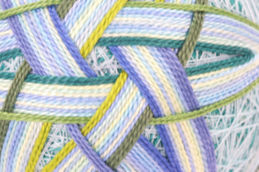


In time, the rhythm of wrapping revealed something deeper — a gesture of care and restoration. This tactile meditation became the seed of my inquiry into healing and, ultimately, into the philosophy of Somaesthetics.

Somaesthetics
Where perception becomes practice — the body as a site of knowing.
Somaesthetics offers a way of understanding art through lived experience — through the body’s capacity to sense, respond, and reflect. It teaches that perception is not passive; it is an active form of creation. In my work, this philosophy becomes a guide: awareness of breath, posture, and movement informs how I see and how I make. The studio becomes a space of inquiry, where the body itself is both instrument and teacher, shaping the art through presence.


My inquiry draws from somaesthetic philosophy, particularly Richard Shusterman’s exploration of perception as embodied awareness.

Touch, as both action and awareness, informs my understanding of making. The motion of wrapping becomes a tactile meditation — a way of sensing connection, care, and the potential for healing

Shusterman situates the body as the prime site for senory experience. He
presents his position that focused attention to the body is not detrimentally distracting, as some would contend, but a means to promote a heightened sense of living.
“Art enchants us through its richly sensuous dimensions perceived through the bodily senses and enjoyed through embodied feelings..” -Richard Shusterman, Thinking Through the Body-

“All perceiving is also thinking, all reasoning is also intuition, all observation is also invention.”
-Rudolf Arnheim, Visual Thinking-

Each influence becomes a thread — woven through time, touch, and awareness — shaping the resonance of my creative life
Artistic Lineage
A conversation across time — listening to the quiet intelligence of those who came before.
The artists who shape my sensibility are those who work with presence — makers who honor material, gesture, and the slow unfolding of form. Their practices remind me that art is a dialogue that stretches across generations, carried through touch, attention, and the courage to stay with what is subtle. In their work, I find companionship and guidance: a way of seeing that deepens my own. This lineage is not about imitation but resonance — the quiet recognition that we are part of something larger, an ongoing conversation held through the act of making.
![th[8].jpg_sm.jpg](https://static.wixstatic.com/media/f0453e_7895479355c5419ba3e5c3594b30ff6f~mv2.jpg/v1/fill/w_216,h_271,al_c,q_80,enc_auto/th%5B8%5D_jpg_sm.jpg)
Drawings of Dale Chilhuly
_JPG.jpg)

Japanese Calligraphy


Andy Goldsworthy


Eva Hesse


_CR2.jpg)
Georgia O'Keefe
Felix Gonzales
